
Retinal disease in Singapore
The retina is the light-sensitive layer at the back of the eye. It converts light into signals that travel along the optic nerve to the brain, where they are read as vision. Retinal disease covers conditions that affect this layer, including diabetic eye disease, age-related macular degeneration, retinal tears and retinal detachment, and other conditions of the retina.
Dr Marcus Tan Chun Jin is a Senior Consultant Ophthalmologist and Director of Glaucoma Services at Eagle Eye Centre. He provides screening, assessment and monitoring for retinal disease, including diabetic eye disease and age-related macular degeneration, and care for general eye conditions such as myopia, which can affect the retina.
Symptoms and when to seek urgent care
Some retinal problems develop slowly, with no symptoms at first. Others start suddenly and need same-day assessment. Seek urgent care the same day if you notice:
A sudden shower of new floaters, or a rapid increase in floaters.
New flashes of light, especially at the edge of your vision.
A dark shadow, veil or curtain moving across part of your vision.
A sudden drop in vision, sudden distortion, or loss of part of your visual field.
These symptoms can be signs of a retinal tear or retinal detachment, which need prompt assessment to protect vision. Do not wait for a routine appointment if they start suddenly. If you notice gradual blurred or distorted central vision, difficulty recognising faces, or straight lines looking bent, book an assessment promptly, as these can be signs of macular disease.
Diabetic eye disease
Diabetes can damage the small blood vessels in the retina, a condition called diabetic retinopathy. It often has no symptoms in its early stages, which is why regular screening matters for people with diabetes, even when vision feels normal. Diabetic eye disease is a leading cause of vision loss among working-age adults in Singapore, and much of that loss can be prevented by regular screening and timely treatment.
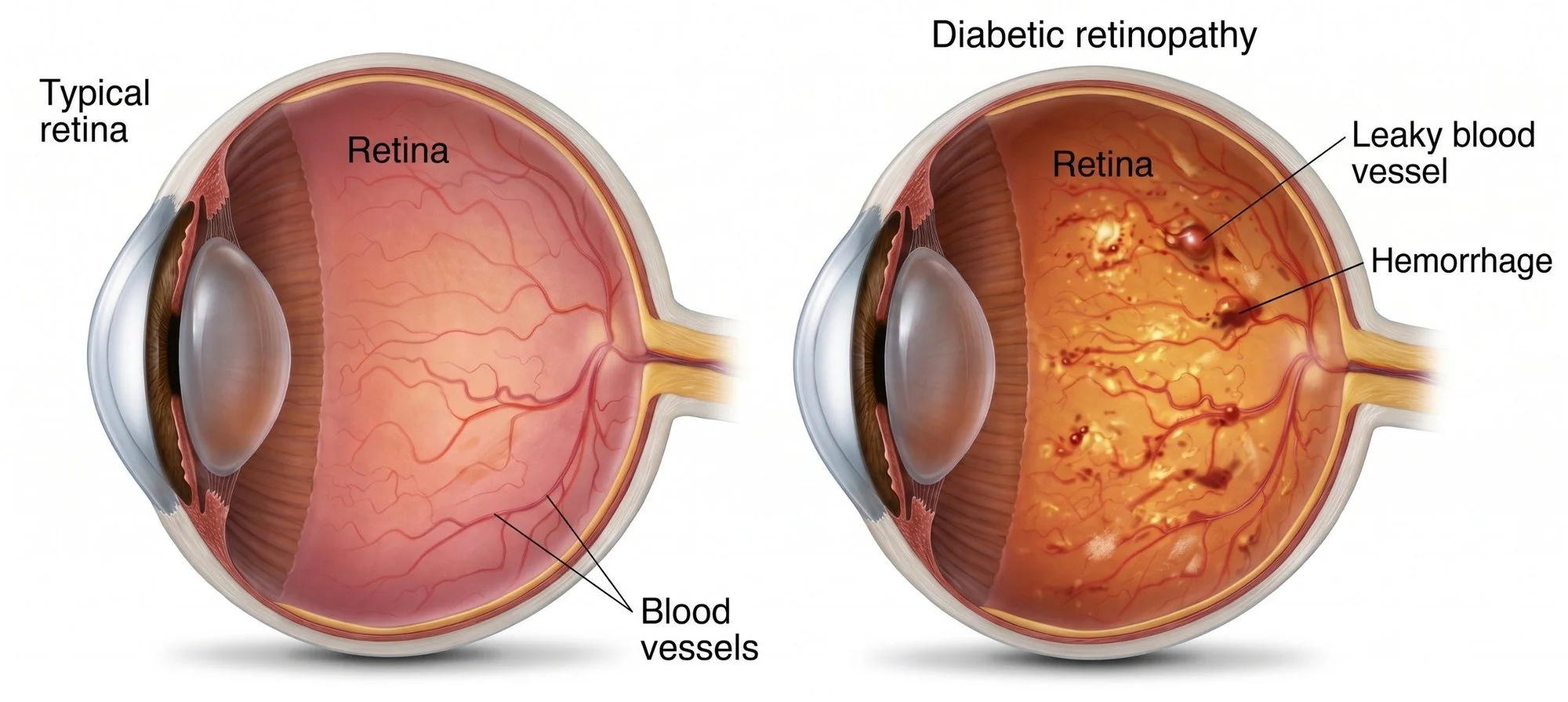
Assessment usually includes a dilated eye examination, retinal photographs, and scans of the retina. Treatment depends on the stage and on whether the centre of the retina, the macula, is affected. Options may include closer monitoring, laser treatment, or injections into the eye, and control of blood sugar, blood pressure and cholesterol also forms part of the plan. Dr Tan will explain the options and work together with you to craft an individualized treatment plan that addresses your specific condition.
Age-related macular degeneration
Age-related macular degeneration, often shortened to AMD, affects the macula, the central part of the retina used for sharp central vision, reading and recognising faces. There are two main forms. Dry AMD is the more common form, in which the macula gradually thins with age. Wet AMD is less common, in which abnormal blood vessels grow under the macula and can leak, causing more rapid loss of central vision.
Dry AMD is usually monitored, with regular review and advice on smoking and general eye health. Wet AMD is usually treated with injections into the eye, given at intervals decided after assessment. Early detection matters, because treatment for wet AMD works best when it starts early. If you notice distorted vision, straight lines looking bent, or a blank or blurred spot in the centre of your vision, book an assessment promptly.
Retinal tears, floaters and retinal detachment
Floaters are small spots, threads or cobweb-like shapes that drift across vision. They are often caused by natural changes in the vitreous gel inside the eye, and many floaters are harmless and become less noticeable over time. Flashes are brief flickers or streaks of light, often at the edge of vision.
A sudden increase in floaters or new flashes can be a sign that the vitreous gel is pulling on the retina, which can cause a retinal tear. A retinal tear can often be treated with laser, to seal the tear and reduce the risk of detachment. If fluid passes through a tear and lifts the retina away from the back of the eye, that is a retinal detachment, which is an eye emergency and usually needs surgery urgently.
What assessment involves
Assessment usually includes a dilated eye examination, so the retina can be seen clearly, retinal photographs, and a scan of the retina called optical coherence tomography, or OCT, where relevant. Other tests, such as fluorescein angiography, may be used where needed to show blood flow in the retina. Bring your glasses or contact lens prescription, a list of your medicines, any previous eye reports or scans, and details of any diabetes or other medical conditions. Arrange transport home, as your pupils will be dilated and your vision may be blurred for some hours after the examination.
Frequently asked questions
What are floaters, and when are they dangerous?
Floaters are small spots, threads or cobwebs that drift across your vision, usually caused by natural changes in the vitreous gel inside the eye. Most floaters are harmless and become less noticeable over time. They are dangerous when they start suddenly, increase rapidly, or come with flashes of light, a dark shadow or curtain, or a sudden drop in vision. Those symptoms need same-day assessment, as they can be signs of a retinal tear or detachment.
How often should I have diabetic eye screening?
That depends on whether diabetic eye disease is present, how advanced it is, and how well your diabetes is controlled. Many people with diabetes are screened once a year, and more often if disease is found or progressing. Dr Tan will set a review interval at your visit, and will advise you to book sooner if your vision changes.
What is the difference between dry and wet macular degeneration?
Dry macular degeneration is the more common form, in which the macula gradually thins with age, and central vision usually changes slowly. Wet macular degeneration is less common, in which abnormal blood vessels grow under the macula and can leak, causing more rapid loss of central vision. Wet macular degeneration is usually treated with injections into the eye, while dry macular degeneration is usually monitored.
Can a retinal detachment be treated?
Yes, usually by surgery, and urgently. The type of surgery depends on the detachment. A retinal tear, which can lead to detachment, can often be treated with laser in the clinic. The key point is prompt assessment: a sudden shower of floaters, flashes, or a dark curtain across vision needs same-day care.
Will I need injections for diabetic eye disease or macular degeneration?
It depends on the condition and its stage. Injections into the eye are a common treatment for wet macular degeneration and for some forms of diabetic eye disease affecting the macula, given at intervals decided after assessment. Not every patient needs them, and some are managed with monitoring or laser treatment instead. Dr Tan will explain which options apply to you at your assessment.
Can I use Medisave or insurance for retinal disease treatment?
Through Eagle Eye Centre's insurance panels, Medisave and MediShield Life can be used where the treatment qualifies. Please check your policy before your visit, or call +65 6456 1000 to check with the clinic.
General information only: this page does not replace medical advice. Diagnosis and treatment suitability are decided after an eye examination and discussion of your individual circumstances.
Book Consultation
Book online through Eagle Eye Centre, or call +65 6456 1000. Dr Tan sees patients at Eagle Eye Centre clinics at King Albert Park, HMI Medical Centre (Farrer Park), Mount Elizabeth Novena, Parkway East and Ang Mo Kio.