
Glaucoma treatment in Singapore
Glaucoma is a group of eye conditions that damage the optic nerve, often linked to raised pressure inside the eye. It can affect sight without symptoms in its early stages, which is why regular monitoring matters: vision lost to glaucoma cannot be restored, so the aim of treatment is to protect the vision you still have.
Dr Marcus Tan Chun Jin is a Senior Consultant Ophthalmologist and Director of Glaucoma Services at Eagle Eye Centre. He provides the full range of glaucoma care, from diagnosis and monitoring through eye drops and laser treatment to minimally invasive glaucoma surgery (MIGS), trabeculectomy and glaucoma drainage implants, including complex and secondary glaucoma.
How fluid drains from the eye
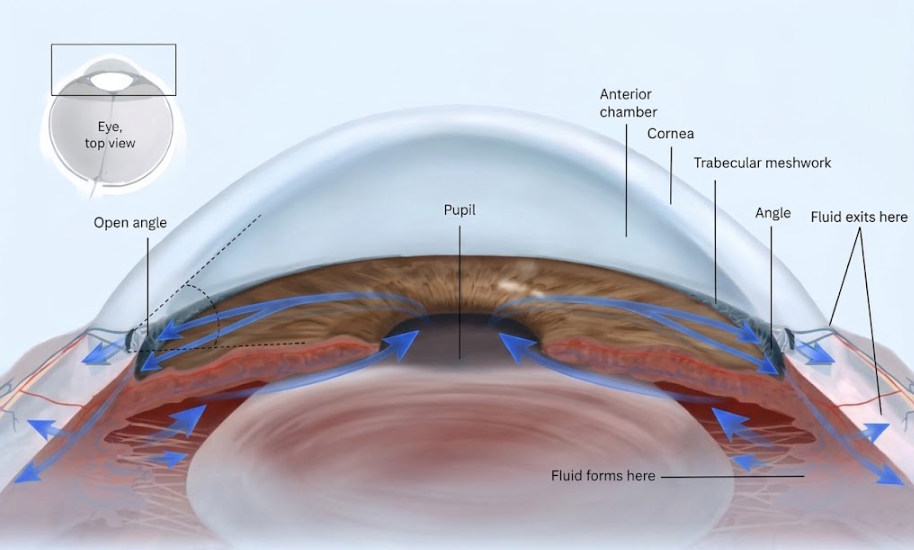
Your eye constantly makes a clear fluid that nourishes its front part, and the same amount must drain away to keep the pressure steady. As the diagram below shows, the fluid is made behind the iris, flows through the front chamber of the eye, and leaves through a tiny drain in the corner (the angle) where the iris meets the cornea. In glaucoma, this drain becomes blocked, so pressure builds up inside the eye. Over time, that pressure can damage the optic nerve.
How glaucoma affects your vision
Many people with early glaucoma notice nothing at all. As the condition progresses, side vision may gradually narrow, often without the person realising it. Seek care if you:
You have a family history of glaucoma or raised eye pressure
You notice gradual loss of side vision or difficulty in dim light
You have other risk factors, such as high myopia or diabetes
You have sudden eye pain, redness, blurred vision, halos, headache or nausea, seek urgent care the same day




Earlier loss is usually patchier, with small areas of reduced vision while central vision is often spared at first.
How glaucoma is diagnosed and monitored
Assessment usually brings together several pieces of information rather than a single test: your eye pressure, the appearance of your optic nerve, your visual field, and scans of the nerve and drainage angle. Dr Tan will explain what each result means for you, how often you need review, and what change would prompt a change in treatment. Bring your glasses or contact lens prescription, a list of your medicines, and any previous eye reports or scans to your appointment.
Treatment options
Treatment is tailored to the type and stage of your glaucoma, your eye pressure target, and your circumstances. Options include:
Monitoring: Regular monitoring, where glaucoma is suspected or early and stable, with scheduled pressure checks, scans and visual field tests.
Eye drops: Prescribed drops to lower eye pressure, with review of how well they are working and whether they suit you.
Laser treatment: Laser treatment to help fluid drain from the eye or to control eye pressure, including angle-based procedures where appropriate.
Minimally invasive glaucoma surgery (MIGS): Procedures such as minimally invasive glaucoma surgery and angle-based surgery (including goniotomy and goniosynechialysis), often chosen for suitable patients at an earlier stage or alongside cataract surgery.
Trabeculectomy: A well-established operation that creates a new drainage pathway to lower eye pressure, usually considered when drops and laser are not enough.
Glaucoma drainage implants: A small implanted device that helps fluid drain and lowers pressure, considered for complex, secondary or previously operated glaucoma. Dr Tan has published the two- and three-year outcomes of the Paul Glaucoma Implant and was lead principal investigator of the first-in-man trial of a novel trans-equatorial drainage device.
Not every option suits every eye. Dr Tan will explain the benefits, risks and alternatives for your situation before you decide together.
Book Consultation
Call +65 6456 1000. Clinics: King Albert Park, HMI Medical Centre (Farrer Park), Mount Elizabeth Novena, Parkway East and Ang Mo Kio.
Frequently asked questions
Can glaucoma be cured?
Vision lost to glaucoma cannot be restored. Treatment aims to lower eye pressure and slow or stop further damage.
Does glaucoma always cause symptoms?
No, early glaucoma often has no symptoms, which is why regular monitoring matters.
Will I need surgery for glaucoma?
Not necessarily. Many people are managed with monitoring, eye drops or laser treatment, and surgery is considered when needed.
How often will I need follow-up?
It depends on the type and stage of glaucoma and how stable it is, and is set at your visit.
Can I use Medisave or insurance for glaucoma treatment?
Through Eagle Eye Centre insurance panels, Medisave and MediShield Life can be used where treatment qualifies. Please check your policy, or call or message +65 6456 1000.
What should I bring to my first appointment?
Your glasses or contact lens prescription, a list of your medicines, previous reports or scans, identification and insurance details. Arrange transport if your pupils will be dilated.
General information only: this page does not replace medical advice. Diagnosis and treatment suitability are decided after an eye examination and discussion of your individual circumstances.